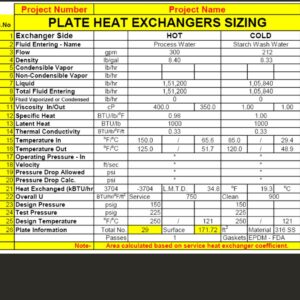
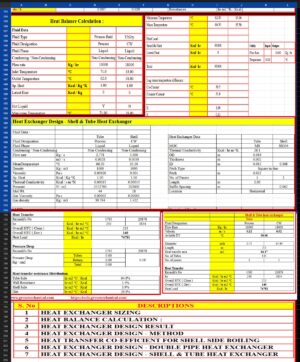
Before running a detailed thermal-hydraulic design in HTRI or Aspen EDR, most heat exchanger projects start with a simpler question: what type of exchanger fits this duty, and roughly how much area will it need? The Heat Exchanger Design Excel Sheet from GrowMechanical answers that question using the LMTD method, giving you heat duty, log mean temperature difference, and required heat transfer area alongside guidance on exchanger type selection.
It is built for chemical, mechanical, and process engineers evaluating heat exchanger options at the concept or FEED stage, and for engineers who need a fast, transparent LMTD calculation without full simulation software.
What This Heat Exchanger Sheet Calculates
- Required heat duty (Q) from process flow rates and temperatures
- Log mean temperature difference (LMTD) for your flow arrangement
- Overall heat transfer coefficient (U) estimate by exchanger type and service
- Required heat transfer area (A)
- Correction factor for non-pure counter-current arrangements
- Estimated pressure drop range by exchanger type
Heat Exchanger Types Covered
| Type |
Best Suited For |
| Shell and Tube |
High-pressure applications; tubes enclosed in a shell, widely used in process industries |
| Plate Heat Exchanger |
Low-viscosity fluids; compact footprint, high heat transfer coefficients |
| Double-Pipe |
Small-scale applications; simple design with one pipe inside another |
| Air-Cooled |
Applications without available cooling water, common in power plants and remote sites |
Key Design Considerations Built Into the Sheet
Heat Transfer Rate
Heat duty is calculated as Q = U × A × ΔTm, where U is the overall heat transfer coefficient, A is surface area, and ΔTm is the log mean temperature difference — the core relationship behind every exchanger sizing calculation.
Flow Arrangement
Parallel, counter-flow, and cross-flow arrangements each affect thermal efficiency differently; counter-flow is generally the most thermally efficient, and the spreadsheet applies the correct LMTD correction factor for your selected arrangement.
Fouling and Pressure Drop
Fouling factors account for deposit buildup that reduces heat transfer efficiency over time, and are included in the overall U estimate. Pressure drop is flagged by exchanger type so you can weigh thermal performance against pumping cost early in the selection process.
Key Features
- Fully editable Excel workbook — no macros or simulation software required
- LMTD method with correction factor for common flow arrangements
- Exchanger type comparison table with typical U-value ranges
- Fouling factor allowance built into the overall coefficient estimate
- Editable summary sheet suitable for concept-stage design documentation
Design Steps This Spreadsheet Follows
- Define thermal requirements: heat duty, inlet/outlet temperatures for both streams
- Select a heat exchanger type based on your application and fluid properties
- Calculate LMTD and required heat transfer area
- Review estimated pressure drop and optimize for energy efficiency
- Carry results forward into detailed mechanical design
Typical Applications
- Chemical and petrochemical process heat exchange duty
- Power generation cooling and heat recovery systems
- HVAC heat exchanger selection
- Concept and FEED-stage exchanger type screening before detailed design
Who Should Use This Calculator
Chemical, mechanical, and process engineers evaluating heat exchanger type and size at the concept or FEED stage, and engineers who need a transparent LMTD-based calculation as a check against detailed simulation software results.
What You’ll Receive
- One fully editable Excel workbook covering LMTD, area, and type selection
- Instant digital download after purchase
- Lifetime access to your downloaded file
- Free updates if the calculation sheet is revised
Compatibility
Compatible with Microsoft Excel 2010 and later, and Excel for Microsoft 365, on Windows and Mac.
For detailed shell-and-tube mechanical design, see our shell and tube heat exchanger Excel sheet. For plate exchanger sizing specifically, see our plate heat exchanger design Excel sheet and plate & frame heat exchanger Excel sheet. If your exchanger feeds a cooling water loop, our centrifugal pump design and selection tool covers the circulation pump. For a complete process package, see the Engineering Design & Calculation Master Excel Bundle, or browse our full library of process engineering Excel calculators.
Frequently Asked Questions
Does this replace detailed simulation software like HTRI or Aspen EDR?
No. This spreadsheet is designed for concept and FEED-stage sizing and type selection using the LMTD method. Detailed thermal-hydraulic design for final equipment specification should still be verified in dedicated simulation software.
Which flow arrangement gives the best performance?
Counter-flow arrangement generally provides the highest thermal efficiency for a given heat transfer area, and the spreadsheet applies the appropriate LMTD correction factor for whichever arrangement you select.
How do I choose between shell-and-tube and plate exchangers?
The type comparison table in this spreadsheet outlines typical use cases: shell-and-tube for high-pressure service, plate exchangers for low-viscosity fluids needing a compact footprint. Fluid properties, pressure rating, and space constraints all factor into the final decision.
Does the spreadsheet account for fouling?
Yes, a fouling factor allowance is included in the overall heat transfer coefficient estimate to account for performance degradation from surface deposits over time.
How is the file delivered?
As an instant digital download immediately after purchase, so you can begin your heat exchanger sizing the same day.
Get Your Heat Exchanger Design Sheet Today
Stop guessing at exchanger type and area before your detailed design. Download the Heat Exchanger Design Excel Sheet and get an LMTD-based sizing and selection estimate in minutes.