

NPSHA DESIGN EXCEL SHEET
₹1,999.00 Original price was: ₹1,999.00.₹1,499.00Current price is: ₹1,499.00. Rupees
In Stock
Cavitation is one of the most common causes of premature pump failure, and it almost always traces back to insufficient NPSH margin at the suction side. The NPSHA Calculation Excel Sheet from GrowMechanical calculates Net Positive Suction Head Available (NPSHA) from your system’s actual conditions, so you can confirm adequate margin against the pump’s NPSH Required (NPSHR) before committing to a design or diagnosing a field problem.
It is built for mechanical, process, and maintenance engineers who need a fast, accurate NPSHA check for pump system design, retrofit, or cavitation troubleshooting.
What This Sheet Calculates
- Net Positive Suction Head Available (NPSHA) from system conditions
- Atmospheric/source pressure head at the fluid surface
- Fluid vapor pressure head at operating temperature
- Static suction head (positive suction head or suction lift)
- Friction and fitting losses in the suction line
- NPSH margin: NPSHA − NPSHR
The NPSHA Formula
NPSHA = ha + hs − hvp − hf
- ha = Absolute pressure head at the liquid surface (atmospheric or vessel pressure)
- hs = Static suction head (positive if flooded suction, negative if suction lift)
- hvp = Vapor pressure head of the fluid at pumping temperature
- hf = Friction and fitting losses in the suction piping
Why NPSH Margin Matters
- Prevent Cavitation: Confirm NPSHA exceeds NPSHR by an adequate margin (commonly 0.5–1 m or per pump vendor guidance) before finalizing suction piping design.
- Save Engineering Time: Apply the standard NPSHA formula without rebuilding it for every project or field check.
- Reduce Errors: A structured calculation reduces the risk of missing a friction loss term or misreading vapor pressure at operating temperature.
Key Features
- Full NPSHA calculation from suction-side system conditions
- Built-in structure for static head, friction loss, and vapor pressure terms
- NPSHA vs. NPSHR margin check against your pump curve data
- Clear unit references to avoid unit-conversion mistakes
- Fully editable formulas — no hidden cells
- Works offline in Microsoft Excel
Technical Specifications
| Parameter | Details |
|---|---|
| File Format | Microsoft Excel (.xlsx) |
| Core Formula | NPSHA = ha + hs − hvp − hf |
| Key Output | NPSHA and margin over pump NPSHR |
| Typical Use | New pump system design, retrofit checks, cavitation troubleshooting |
| Editable | Yes — all formulas open for review |
| Internet Required | No — works fully offline |
Typical Applications
- New centrifugal pump suction piping design
- Pump retrofit and upgrade evaluations
- Field troubleshooting of cavitating or noisy pumps
- Elevated-temperature or vacuum-service pump systems where vapor pressure margin is critical
- Vendor pump curve cross-checks
Who Should Use This Sheet
- Mechanical and process engineers designing pump suction systems
- Plant maintenance engineers diagnosing cavitation issues
- EPC engineers preparing pump system calculation packages
- Engineering students learning NPSH fundamentals
What You’ll Receive
- Editable Excel sheet with full NPSHA calculation
- Structured input fields for static head, friction loss, and vapor pressure
- Lifetime access with a single, one-time purchase
Compatibility
- Microsoft Excel 2010 or later (Windows or Mac)
- No macros or add-ins required
- Works fully offline once downloaded
How to Use This Sheet
- Enter the source pressure (atmospheric or vessel pressure) at the liquid surface.
- Enter static suction head or lift based on your piping layout.
- Enter the fluid’s vapor pressure at the actual pumping temperature.
- Enter suction line friction and fitting losses.
- Review the calculated NPSHA and compare it against your pump’s NPSHR from the vendor curve.
For complete pump sizing beyond NPSHA, see our Centrifugal Pump Design & Selection Excel Tool and Centrifugal Pump Design Excel Sheet. See also our Pump Head Design Excel Sheet. Explore the Engineering Design & Calculation Master Excel Bundle, or browse the complete product catalog.
Frequently Asked Questions
What’s the difference between NPSHA and NPSHR?
NPSHA (Available) is a property of your system — the suction-side pressure margin above the fluid’s vapor pressure. NPSHR (Required) is a property of the specific pump, published on its performance curve. Cavitation risk exists whenever NPSHA is too close to or below NPSHR.
What margin should I target between NPSHA and NPSHR?
Common practice targets at least 0.5–1 m (or per pump manufacturer/API guidance) of margin, with larger margins recommended for high-energy, high-suction-energy, or critical services. Always confirm the required margin with your pump vendor and applicable project standard.
Why does fluid temperature matter for NPSHA?
Vapor pressure rises sharply with temperature. Hotter fluids have less NPSH margin for the same physical layout, which is why NPSHA must be recalculated for elevated-temperature services rather than assumed from ambient-temperature values.
Can this sheet be used for troubleshooting an existing pump?
Yes. Many engineers use this calculation to check NPSHA at actual field operating conditions when diagnosing cavitation noise, vibration, or impeller damage on an in-service pump.
Does this replace the need for a pump vendor’s NPSHR curve?
No. This sheet calculates your system’s NPSHA; you still need the pump’s NPSHR value from its published performance curve to check the margin.
Ready to confirm your pump system has adequate NPSH margin? Get the NPSHA Calculation Excel Sheet today and check your suction system before cavitation becomes a reliability problem.
Related products
-
 Sale!
Sale!
PUMP SIZING CALCULATION
₹3,999.00Original price was: ₹3,999.00.₹2,999.00Current price is: ₹2,999.00. Sale! Add to cart Add to cart Quick View -
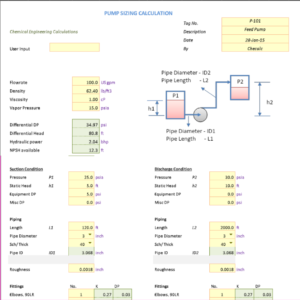
PUMP DESIGN EXCEL SHEET
₹2,999.00 Rupees Add to cart Add to cart Quick View -
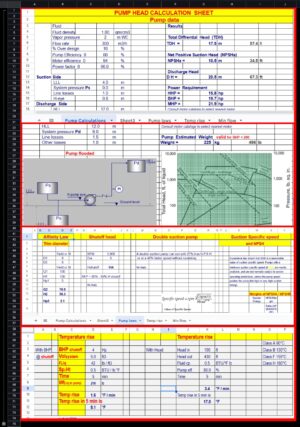 Sale!
Sale!
PUMP DESIGN EXCEL SHEET
₹2,999.00Original price was: ₹2,999.00.₹1,999.00Current price is: ₹1,999.00. Sale! Add to cart Add to cart Quick View -
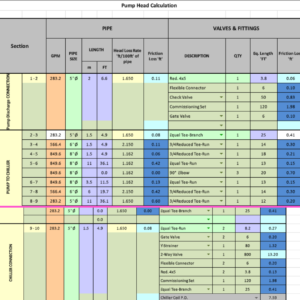 Sale!
Sale!
PUMP HEAD DESIGN EXCEL SHEET
₹3,499.00Original price was: ₹3,499.00.₹1,499.00Current price is: ₹1,499.00. Rupees Sale! Add to cart Add to cart Quick View

