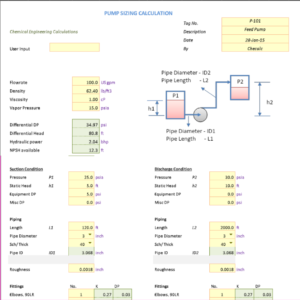
When a single impeller can’t develop enough head for your duty, the answer is usually a multistage pump — several impellers in series, each adding its own head increment. Sizing one correctly means working out head per stage, the resulting stage count, and the power and thrust implications of staging impellers together. The Multistage Pump Design Excel Sheet from GrowMechanical works through this calculation for high-head centrifugal pump applications.
It is built for mechanical and process engineers sizing multistage centrifugal pumps for high-head duties such as boiler feed, high-rise water supply, RO feed, and high-pressure process transfer.
What This Sheet Calculates
- Head developed per stage (per-impeller head increment)
- Required number of stages to reach total system head: N = Htotal / Hstage
- Total power requirement across all stages
- Axial thrust consideration from staged impellers (balancing drum/disc awareness)
- Overall pump efficiency for the multistage configuration
Why Multistage Sizing Is Different
- Head Builds in Series: Each stage adds to total head, so getting per-stage head right directly determines how many stages (and how long/expensive) the pump will be.
- Thrust Accumulates: Multiple impellers in series increase axial thrust, which single-stage sizing sheets don’t need to account for.
- Efficiency Compounds: Overall efficiency reflects losses across every stage, not just one impeller.
Key Features
- Per-stage head and total head build-up calculation
- Automatic stage count estimation for your target head
- Total power calculation across all stages
- Axial thrust awareness for multistage configurations
- Fully editable formulas — no hidden cells
- Works offline in Microsoft Excel
Technical Specifications
| Parameter |
Details |
| File Format |
Microsoft Excel (.xlsx) |
| Core Relationship |
Number of stages = Total head ÷ head per stage |
| Key Outputs |
Stage count, total power, thrust consideration, overall efficiency |
| Typical Applications |
Boiler feed, high-rise water supply, RO feed, high-pressure transfer |
| Editable |
Yes — all formulas open for review |
| Internet Required |
No — works fully offline |
Typical Applications
- Boiler feed water pump sizing
- High-rise building water supply systems
- Reverse osmosis (RO) high-pressure feed pumps
- High-pressure process fluid transfer
Who Should Use This Sheet
- Mechanical and process engineers sizing high-head pump systems
- EPC engineers preparing multistage pump data sheets
- Plant engineers evaluating multistage pump vendor proposals
- Engineering students learning multistage pump fundamentals
What You’ll Receive
- Editable Excel sheet with multistage pump sizing calculations
- Per-stage head, stage count, power, and thrust outputs
- Lifetime access with a single, one-time purchase
Compatibility
- Microsoft Excel 2010 or later (Windows or Mac)
- No macros or add-ins required
- Works fully offline once downloaded
How to Use This Sheet
- Enter your total required head and design flow rate.
- Enter the expected head developed per stage (from vendor or preliminary impeller data).
- Review the calculated number of stages required.
- Review total power requirement and thrust considerations across all stages.
- Cross-check the result against your multistage pump vendor’s proposal.
For single-stage centrifugal pump sizing, see our Centrifugal Pump Design & Selection Excel Tool and Single Stage Centrifugal Pump Design Excel Sheet. Check suction margin with our NPSHA Calculation Excel Sheet. Explore the Engineering Design & Calculation Master Excel Bundle, or browse the complete product catalog.
Frequently Asked Questions
When do I need a multistage pump instead of a single-stage pump?
When your total required head exceeds what a single impeller can reasonably or efficiently develop, a multistage pump splits the head across several impellers in series, which is more practical than an oversized single-stage design.
How does axial thrust change with more stages?
Each impeller stage contributes axial thrust, and thrust accumulates across stages. Multistage pumps typically use balancing drums, disks, or opposed impeller arrangements to manage this, which is why thrust awareness matters more here than for single-stage pumps.
Does this sheet size the impellers themselves?
No, this sheet calculates the system-level parameters — stage count, total power, and head build-up — based on a known or estimated per-stage head. Detailed impeller hydraulic design is typically handled by the pump manufacturer.
Can this be used for boiler feed pump applications?
Yes, boiler feed pumps are a common multistage application given their high head requirements; confirm final selection against boiler feed-specific standards (such as applicable ASME/API guidance) for your project.
How many stages is “too many”?
There’s no fixed limit, but very high stage counts increase pump length, cost, and mechanical complexity. If your calculated stage count seems excessive, consider re-evaluating system head requirements or exploring higher-head-per-stage pump designs.
Sizing a high-head pump application? Get the Multistage Pump Design Excel Sheet today and calculate the stage count, power, and thrust considerations before you commit to a pump selection.