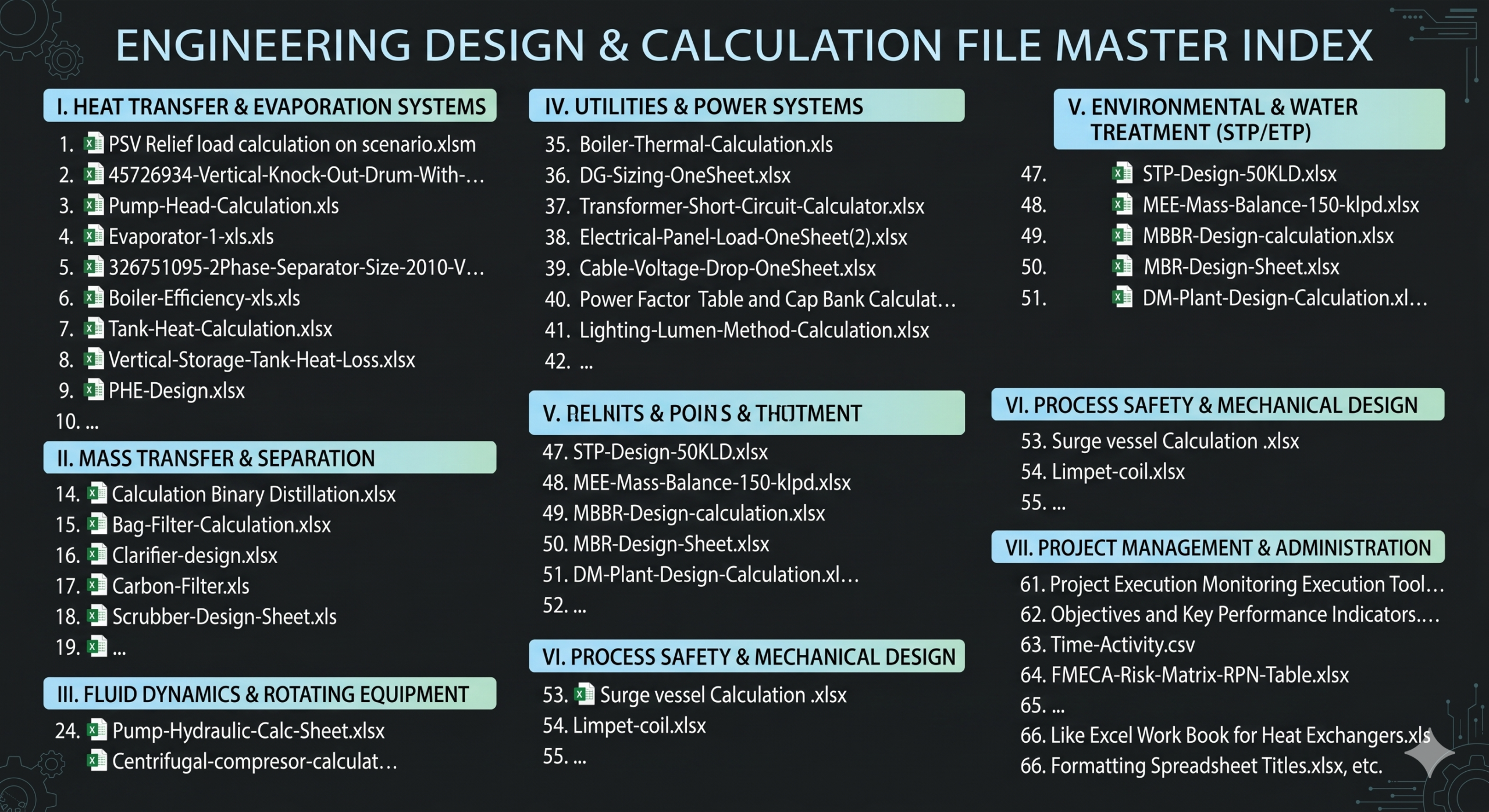
Every process, mechanical and chemical engineer knows the quiet time-sink of plant design: rebuilding the same calculation spreadsheet from scratch on every project. A new client, a new heat exchanger duty, a new pump curve — and you are once again wiring up formulas, chasing correlation references, and formatting a data sheet that already existed on the last job. Engineering design Excel templates exist to end that cycle. This guide explains what they are, why productised calculation sheets are becoming standard in EPC and consultancy work, and how a single library can cover most of your equipment-sizing workload.
What are engineering design Excel templates?
An engineering design Excel template is a pre-built, validated spreadsheet that performs a specific sizing or rating calculation — for example, thermal design of a shell-and-tube heat exchanger, hydraulic sizing of a centrifugal pump, or the rating of a packed scrubber. Instead of a blank sheet, you get structured input cells, embedded engineering correlations, unit handling, and a clean output block that mirrors real EPC deliverables.
Good templates go beyond a single calculation. A complete set follows the way engineering is actually delivered on a project: a sizing or rating calculation, a process data sheet (PDS), and a technical bid analysis (TBA) for each major equipment type. That is exactly the structure behind our complete list of chemical plant equipment design templates, which maps hundreds of genuine deliverables across sixteen equipment and system categories.
Why productised calculation sheets save real engineering hours
The value is not just convenience — it is consistency and defensibility. When your calculations live in a proven template, you get several compounding benefits:
- Speed: A sizing case that takes half a day to build from scratch takes minutes when the engine already exists. You change inputs, not formulas.
- Accuracy: Correlations, unit conversions and design margins are set once and validated, removing the copy-paste errors that creep into ad-hoc sheets.
- Traceability: Reviewers and clients can follow a familiar, standardised layout — the same look as an EPC-issued data sheet.
- Reusability: One strong data-sheet template covers many equipment types with light per-type editing, so your library scales faster than your workload.
This is the core idea behind Grow Mechanical: treating engineering delivery as a product, not a one-off. You buy the tested calculation once and reuse it across every project.
What a complete equipment-sizing library covers
Our flagship Engineering Design & Calculation Master Excel Bundle (65+ Industrial Sheets) was built to be a single source for the calculations engineers reach for most often. Here is how the disciplines break down.
Heat exchanger design

Thermal design and rating are among the most requested calculations in any plant. Templates cover LMTD and effectiveness-NTU methods, surface area and duty checks, and pressure-drop estimation. Explore dedicated tools such as the heat exchanger design Excel sheet and the plate heat exchanger design Excel sheet, or browse the full heat exchanger category.
Centrifugal pump sizing
Pump hydraulics decide whether a system actually delivers flow. Templates handle total dynamic head, NPSH available versus required, power and efficiency, and system-curve checks — everything you need to specify and verify a pump. See the centrifugal pump design category.
Compressor sizing and selection
From polytropic head to power and discharge-temperature checks, compressor worksheets support both selection and verification for gas-handling duties. Browse the compressor design category.
Scrubber and absorber design
Emission-control and mass-transfer equipment need careful rating. Scrubber templates cover gas and liquid loading, packing height and diameter, and removal efficiency. See the scrubber system design category.
Documentation: PDS, MTO/BOQ and technical bid analysis
Sizing is only half the deliverable. A complete package includes the process data sheets that specify the equipment, the material take-off and bill of quantities that price it, and the technical bid analysis that compares vendor offers on a like-for-like basis. These documentation templates turn raw calculations into issue-ready EPC deliverables.
Who these templates are for
They fit a wide range of users: freelance and in-house process engineers who need to move fast, consultancies standardising their deliverables, EPC teams preparing bid and detailed-design packages, and engineering students learning how real sizing calculations are structured. If you specify, verify, or review equipment, a validated template pays for itself on the first job.
How to work with an engineering Excel template
- Enter your process conditions — flows, temperatures, pressures, fluid properties — into the clearly marked input cells.
- Review the calculated outputs and design margins, adjusting assumptions where your project standard differs.
- Export the data sheet for issue, or feed the results straight into your MTO/BOQ and technical bid analysis.
Prefer to try before you buy? Several live, browser-based calculators are available on our online engineering tools platform, so you can validate the approach before downloading the full library.
Start with the full library
If your work spans multiple equipment types, the most economical route is the complete bundle rather than single sheets. The 65+ sheet master bundle currently runs at a launch price well below the sum of individual templates, and it grows over time. You can also browse everything in the equipment sizing shop or read more practical guides on the Grow Mechanical blog.
Have a specific requirement or need a custom calculation built to your standard? Talk to an engineer or message us directly on WhatsApp.
Frequently asked questions
Are engineering design Excel templates suitable for EPC deliverables?
Yes. The templates follow real EPC practice — sizing/rating calculation, process data sheet and technical bid analysis per equipment type — so the outputs match the format reviewers and clients expect.
Do I need special software to use them?
No. The templates run in standard Microsoft Excel. There are no macros to install for the core calculations, so they open and edit like any normal workbook.
Can I edit the formulas and layout?
Yes. The sheets are editable so you can adapt correlations, design margins and formatting to your company or project standard.
Is it cheaper to buy the full bundle or individual sheets?
If you work across several equipment types, the 65+ sheet master bundle is far more economical than buying sheets individually, and it expands over time at the same price.
Do you build custom calculation templates?
Yes. If you need a calculation built to a specific standard or duty, contact the Grow Mechanical team and we will scope it with you.

