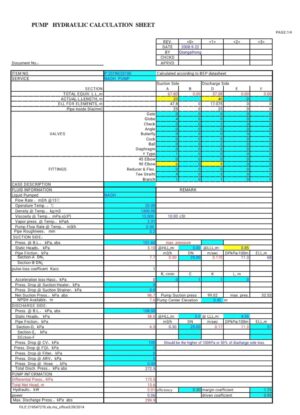
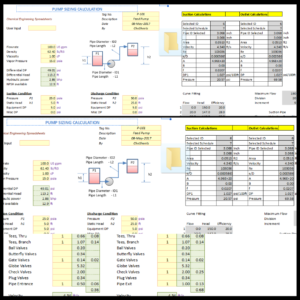
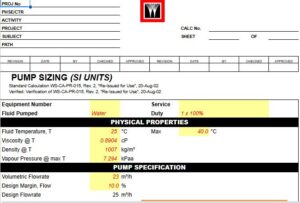
Positive displacement (PD) pumps don’t follow a head-flow curve the way centrifugal pumps do — flow is set primarily by displacement volume and speed, with volumetric efficiency (slip) determining how much of that theoretical flow is actually delivered. The Positive Displacement Pump Sizing Excel Sheet from GrowMechanical works through this different calculation basis for gear, screw, diaphragm, and piston pump applications.
It is built for process and mechanical engineers sizing PD pumps for metering, high-viscosity fluid transfer, and high-pressure duties where centrifugal pumps aren’t suitable.
What This Sheet Calculates
- Theoretical flow rate from displacement volume per revolution and speed
- Actual delivered flow accounting for slip/volumetric efficiency
- Required power based on differential pressure and flow
- Volumetric efficiency loss due to internal clearances and fluid viscosity
- Pressure rating considerations for the selected PD pump type
Why PD Pump Sizing Is Different
| Centrifugal Pumps |
Positive Displacement Pumps |
| Flow depends on system head (head-flow curve) |
Flow depends primarily on displacement volume × speed |
| Flow varies significantly with discharge pressure |
Flow stays nearly constant regardless of discharge pressure (within pump limits) |
| Poor fit for high-viscosity or metering duties |
Well suited to high-viscosity, metering, and high-pressure duties |
Key Features
- Displacement-based flow calculation (not head-flow curve based)
- Volumetric efficiency/slip accounting for gear, screw, diaphragm, and piston types
- Power calculation from differential pressure and actual delivered flow
- Fully editable formulas — no hidden cells
- Works offline in Microsoft Excel
Technical Specifications
| Parameter |
Details |
| File Format |
Microsoft Excel (.xlsx) |
| Pump Types Covered |
Gear, screw, diaphragm, and piston (reciprocating) PD pumps |
| Core Relationship |
Actual flow = displacement/rev × speed × volumetric efficiency |
| Key Outputs |
Theoretical flow, actual flow, power, volumetric efficiency |
| Editable |
Yes — all formulas open for review |
| Internet Required |
No — works fully offline |
Typical Applications
- Chemical dosing and metering pump sizing
- High-viscosity fluid transfer (oils, polymers, slurries)
- High-pressure process transfer where centrifugal pumps aren’t suitable
- Hydraulic power unit pump sizing
Who Should Use This Sheet
- Process and mechanical engineers sizing PD pumps
- EPC engineers preparing PD pump data sheets
- Plant engineers evaluating metering or dosing pump performance
- Engineering students learning PD pump sizing fundamentals
What You’ll Receive
- Editable Excel sheet with PD pump sizing calculations
- Flow, slip, and power outputs for gear, screw, diaphragm, and piston types
- Lifetime access with a single, one-time purchase
Compatibility
- Microsoft Excel 2010 or later (Windows or Mac)
- No macros or add-ins required
- Works fully offline once downloaded
How to Use This Sheet
- Enter the pump’s displacement volume per revolution and operating speed.
- Enter expected volumetric efficiency (slip) based on fluid viscosity and internal clearances.
- Review the calculated theoretical and actual delivered flow.
- Enter differential pressure to calculate required power.
- Cross-check the result against your PD pump vendor’s published performance data.
For centrifugal pump sizing, see our Centrifugal Pump Design & Selection Excel Tool and Pump Power Calculation Excel Sheet. Check suction margin with our NPSHA Calculation Excel Sheet. Explore the Engineering Design & Calculation Master Excel Bundle, or browse the complete product catalog.
Frequently Asked Questions
Why doesn’t flow change much with discharge pressure for PD pumps?
Because flow is set by displacement volume and speed rather than a head-flow relationship, PD pumps deliver approximately constant flow across a wide discharge pressure range, up to their mechanical and pressure rating limits.
What causes volumetric efficiency (slip) losses?
Internal clearances between moving parts allow some fluid to leak back from the discharge to suction side. Slip increases with lower fluid viscosity, higher differential pressure, and worn internal clearances.
When should I choose a PD pump instead of a centrifugal pump?
PD pumps are typically preferred for high-viscosity fluids, precise metering/dosing duties, and high-pressure, low-flow applications where centrifugal pumps become inefficient or impractical.
Does this sheet cover gear, screw, diaphragm, and piston pumps equally?
Yes, the underlying displacement-based flow and slip calculation applies across these PD pump types; input pump-specific displacement and slip data for accurate results.
Does this replace a PD pump vendor’s selection software?
No. This sheet provides a sizing estimate; final selection should be confirmed with your PD pump manufacturer’s published performance and pressure rating data.
Sizing a positive displacement pump for your process? Get the Positive Displacement Pump Sizing Excel Sheet today and calculate actual flow and power correctly — not with a centrifugal pump assumption.