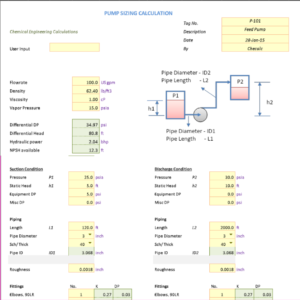
Getting flow rate and head right is only half of pump sizing — the motor still has to be sized correctly, and that means working through hydraulic power, shaft power, and pump efficiency properly. This Pump Power Calculation Excel Sheet from GrowMechanical focuses specifically on this power and efficiency chain, helping you specify a motor that’s neither undersized nor unnecessarily oversized.
It is built for mechanical and process engineers sizing pump drivers and confirming motor power requirements for centrifugal pump applications.
What This Sheet Calculates
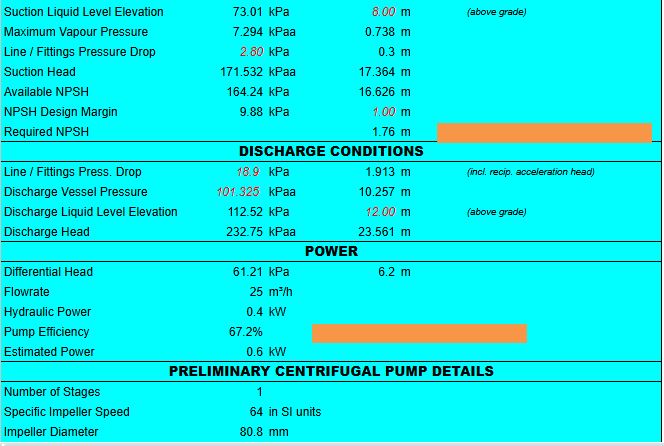
- Hydraulic power delivered to the fluid: Ph = ρ × g × Q × H
- Shaft (brake) power required at the pump: Ps = Ph / ηpump
- Motor power with recommended service factor margin
- Overall pump efficiency from hydraulic and shaft power
The Power Calculation Chain
| Step |
Calculation |
| 1. Hydraulic Power |
Ph = ρ × g × Q × H (power actually delivered to the fluid) |
| 2. Shaft Power |
Ps = Ph ÷ pump efficiency (accounts for internal pump losses) |
| 3. Motor Power |
Motor rating = Ps × service factor margin (typically 10–20%) |
Why Use This Power Calculation Sheet
- Avoid Undersized Motors: A motor sized only to hydraulic power (ignoring pump efficiency losses) will overload and trip.
- Avoid Wasted Capital: Excessive margins on top of shaft power lead to oversized, inefficient motors and higher upfront cost.
- Save Engineering Time: Apply the standard hydraulic-to-shaft-to-motor power chain without rebuilding it for every project.
Key Features
- Full power chain calculation: hydraulic, shaft, and motor power
- Pump efficiency input to correctly account for internal losses
- Configurable motor service factor margin
- Fully editable formulas — no hidden cells
- Works offline in Microsoft Excel
Technical Specifications
| Parameter |
Details |
| File Format |
Microsoft Excel (.xlsx) |
| Core Formulas |
Ph = ρgQH; Ps = Ph/η; Motor = Ps × margin |
| Key Outputs |
Hydraulic power, shaft power, recommended motor rating |
| Editable |
Yes — all formulas open for review |
| Internet Required |
No — works fully offline |
Typical Applications
- Motor sizing for new centrifugal pump installations
- Driver upgrade evaluations for existing pumps
- Vendor motor rating cross-checks
- Energy audits comparing actual vs. required pump power
Who Should Use This Sheet
- Mechanical and process engineers specifying pump motors
- EPC engineers preparing pump and driver data sheets
- Plant engineers evaluating motor upgrades or replacements
- Engineering students learning pump power fundamentals
What You’ll Receive
- Editable Excel sheet with hydraulic, shaft, and motor power calculations
- Configurable efficiency and service factor inputs
- Lifetime access with a single, one-time purchase
Compatibility
- Microsoft Excel 2010 or later (Windows or Mac)
- No macros or add-ins required
- Works fully offline once downloaded
How to Use This Sheet
- Enter design flow rate and total head.
- Enter the pump’s efficiency at the design operating point (from the vendor curve).
- Review the calculated hydraulic and shaft power.
- Apply a service factor margin to determine the recommended motor rating.
- Cross-check against the vendor’s proposed motor size.
For complete pump sizing, see our Centrifugal Pump Design & Selection Excel Tool and Centrifugal Pump Design Excel Sheet. Check suction-side margin with our NPSHA Calculation Excel Sheet. Explore the Engineering Design & Calculation Master Excel Bundle, or browse the complete product catalog.
Frequently Asked Questions
What’s the difference between hydraulic power and shaft power?
Hydraulic power is the power actually delivered to the fluid. Shaft power is higher, because it also accounts for internal pump losses (mechanical, volumetric, hydraulic losses inside the pump) represented by pump efficiency.
What service factor margin should I use for the motor?
A common range is 10–20% above calculated shaft power, though the appropriate margin depends on your project standard, duty type, and motor manufacturer recommendations.
Can this sheet be used to check a vendor’s proposed motor size?
Yes. Many engineers use this calculation to independently verify that a vendor-proposed motor rating is appropriate for the pump’s actual duty point.
Does pump efficiency change with operating point?
Yes, pump efficiency varies across the flow-head curve. Use the efficiency value at your actual design operating point, not just the best efficiency point (BEP), for an accurate power calculation.
Is this sheet specific to centrifugal pumps?
The power chain calculation (hydraulic to shaft to motor power) applies broadly, though the typical efficiency ranges referenced are most representative of centrifugal pump applications.
Ready to size your pump motor correctly? Get the Pump Power Calculation Excel Sheet today and specify a motor rating backed by the full hydraulic-to-shaft-to-motor power chain.