Choosing the right filter isn’t just about calculating a required area — different filter types (cartridge, bag, basket, pleated, depth) have very different recommended flow-velocity ranges, and using the wrong velocity assumption leads to undersized or oversized filters. The Filter Sizing Calculation Spreadsheet from GrowMechanical gives you type-specific sizing data alongside the core area and pressure-drop calculations, so you can size and compare filter options correctly for your process duty.
It is built for process and mechanical engineers selecting or comparing filtration equipment for chemical, oil and gas, pharmaceutical, food processing, and water treatment applications.
Key Factors in Filter Sizing
- Flow Rate (Q): The volumetric or mass flow rate (m³/hr or LPM) determines the surface area required for effective filtration.
- Operating Pressure & Pressure Drop (ΔP): Filters should operate within a permissible pressure drop range (typically 0.5–1.5 bar) to ensure system stability. A high pressure drop signals clogging or an undersized filter.
- Filtration Rating (Micron Size): The required particle retention size (e.g., 1 µm, 5 µm) defines filter media and construction. Finer ratings generally need larger surface area to avoid frequent blockage.
- Fluid Properties: Viscosity, temperature, chemical compatibility, and density all influence filter selection and sizing.
- Filter Type & Configuration: Cartridge, bag, basket, pleated, and depth filters each have different flow capacities, surface areas, and orientation options.
Filter Type Comparison & Recommended Velocity Ranges
| Filter Type |
Typical Use Case |
Relative Surface Area Needed |
| Cartridge Filter |
Fine liquid polishing, low-to-medium flow |
Higher (fine micron ratings need more area) |
| Bag Filter |
Medium-to-high flow, moderate solids loading |
Moderate |
| Basket Filter |
Coarse filtration, high solids loading, strainer duty |
Lower (coarse rating, robust for solids) |
| Pleated Filter |
High-efficiency filtration in compact housing |
Moderate to high (increased effective area via pleats) |
| Depth Filter |
Gradual density media, long service life for varying particle sizes |
Moderate |
Basic Filter Sizing Relationship (Liquid Filtration)
The core sizing relationship used across filter types is:
A = Q / V
- A = Required filter area (m²)
- Q = Flow rate (m³/hr or LPM)
- V = Recommended flow velocity for the selected filter type (m/hr or LPM/m²)
The spreadsheet applies this relationship using type-specific velocity guidance, rather than a single generic value, so the calculated area better reflects the filter type you’re evaluating.
Key Features
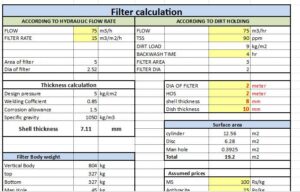
- Filter area calculation using type-specific recommended velocity ranges
- Pressure drop check against your permissible operating range
- Side-by-side comparison across cartridge, bag, basket, pleated, and depth filter types
- Micron rating guidance to help match filtration fineness to your process needs
- Fully editable formulas — no hidden cells
- Works offline in Microsoft Excel
Technical Specifications
| Parameter |
Details |
| File Format |
Microsoft Excel (.xlsx) |
| Core Formula |
A = Q / V (area from flow rate and recommended velocity) |
| Filter Types Compared |
Cartridge, bag, basket, pleated, depth |
| Typical Pressure Drop Range |
0.5 – 1.5 bar (project-dependent) |
| Editable |
Yes — all formulas open for review |
| Internet Required |
No — works fully offline |
Typical Applications
- Chemical and petrochemical process filtration
- Oil and gas produced-water and fuel filtration systems
- Pharmaceutical and food-grade liquid filtration
- Water and wastewater treatment filtration
- Filter type comparison and vendor proposal evaluation
Who Should Use This Spreadsheet
- Process and mechanical engineers selecting filtration equipment
- EPC engineers preparing filter specification sheets
- Plant engineers troubleshooting filter pressure drop or clogging issues
- Engineering students studying filtration and separation processes
What You’ll Receive
- Editable Excel spreadsheet with filter area and pressure drop calculations
- Type-specific velocity comparison table (cartridge, bag, basket, pleated, depth)
- Lifetime access with a single, one-time purchase
Compatibility
- Microsoft Excel 2010 or later (Windows or Mac)
- No macros or add-ins required
- Works fully offline once downloaded
How to Use This Spreadsheet
- Enter your process flow rate and fluid properties.
- Select or compare filter types using the recommended velocity table.
- Review the calculated required filter area for each filter type.
- Check the estimated pressure drop against your permissible range.
- Use the comparison to select the filter type and size for your application.
For related equipment, see our Filter Design Excel Sheet, Scrubber Design and Selection Excel Sheet, and Fuel Gas Scrubber Design Excel Sheet. Explore the Engineering Design & Calculation Master Excel Bundle, browse the complete product catalog, or try our free online engineering calculators.
Frequently Asked Questions
How is this different from the Filter Design Excel Sheet?
This spreadsheet focuses on comparing filter types (cartridge, bag, basket, pleated, depth) with type-specific velocity data so you can choose between filter options. Our Filter Design Excel Sheet focuses on sizing a single selected filter design in more detail.
What flow velocity should I use for cartridge filters vs. bag filters?
Recommended velocities vary by filter type and manufacturer data; the spreadsheet provides typical relative guidance so you can compare options before confirming exact values with your filter vendor’s data sheet.
Does this spreadsheet check pressure drop as well as area?
Yes. It calculates the required filter area and checks the resulting pressure drop against a permissible range so you can confirm the filter won’t clog prematurely or oversize your system.
Can I use this for both liquid and gas filtration?
The core area relationship (A = Q/V) applies to both, though velocity and pressure drop guidance differ by fluid phase — always confirm against your specific process fluid properties.
Is this suitable for vendor proposal comparison?
Yes. Many engineers use this spreadsheet to independently check vendor-proposed filter sizes and types before finalizing equipment selection.
Ready to compare and size the right filter for your process? Get the Filter Sizing Calculation Spreadsheet today and choose the correct filter type and area with confidence.