An elbow is a fundamental pipe fitting used in process piping to change the direction of fluid flow, typically by 45°, 90°, or 180°, with geometry and design directly affecting pressure drop, layout flexibility, and overall system reliability in process plants.
What is an elbow?
An elbow is a curved piping component installed between two pipe sections to alter the flow direction without significantly disturbing flow continuity. In process plants, elbows are used extensively in pressure piping systems to route lines around equipment, structures, and no-go zones while maintaining mechanical integrity and hydraulic performance.
Common elbow angles
Standard elbow angles in process piping are 45°, 90°, and 180°, although intermediate angles such as 22.5° are also used for special routing requirements. A 45° elbow produces a smoother direction change with lower pressure loss, while 90° and 180° elbows produce higher local losses and must be considered carefully during hydraulic design.
Long radius vs short radius
Elbows are classified by radius ratio R/D, where R is the centerline radius and D is the nominal pipe diameter. Long-radius (LR) elbows have R ≈ 1.5D and are preferred in process piping because they reduce turbulence and pressure drop, while short-radius (SR) elbows with R ≈ 1D are used where space is highly constrained but at the cost of higher losses and potential erosion.
Seamless, welded, and fabricated
Seamless elbows are manufactured from seamless pipe or forged blocks and are typically used for high-pressure, high-temperature, or severe cyclic service because they avoid weld-line weaknesses. Welded or fabricated elbows are made by welding segments or plates and are more common for large diameters or low-to-medium pressure systems where cost optimization is important.
Standards and dimensions
In process plants, butt-welded elbows are generally designed and manufactured as per ASME B16.9 for factory-made wrought buttwelding fittings. This standard defines the dimensional envelope for long- and short-radius 45° and 90° elbows (center-to-end dimensions, outside diameter, and tolerances) for a wide range of nominal pipe sizes.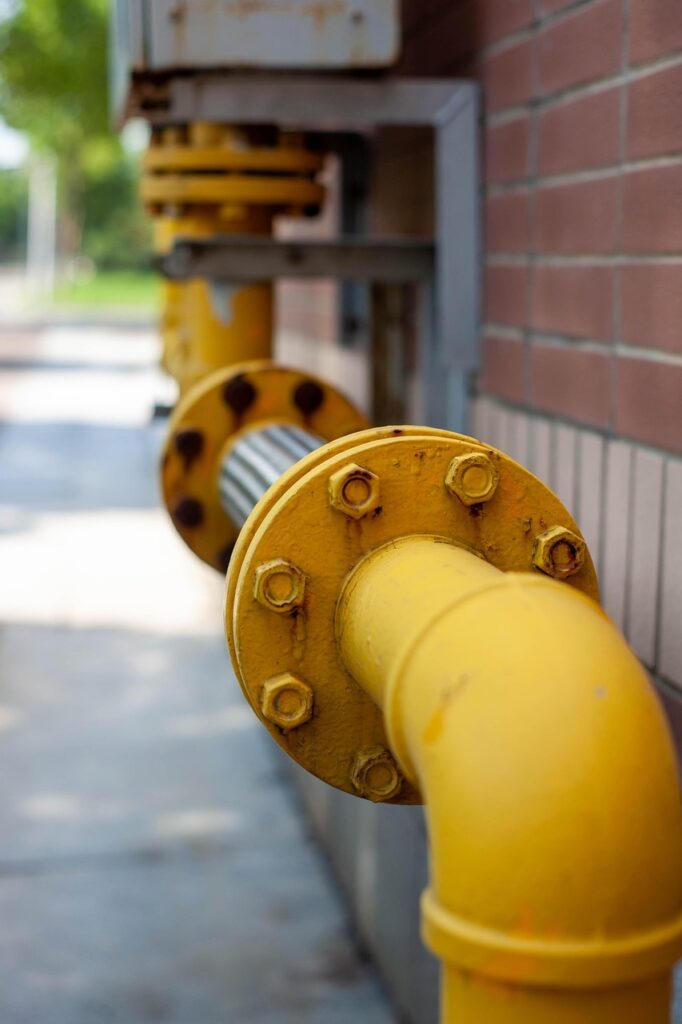
Types of elbows in process piping
Important elbow types in process design include:
– 90° LR and SR elbows for standard direction change.
– 45° LR elbows for reduced pressure drop and smoother flow.
– 180° return bends for U-turns in heater coils, heat exchangers, and compact layouts.
Additional variants such as mitered elbows or multi-piece fabricated bends are used for very large diameters where standard forged fittings are not economical.
Reducing elbows
A reducing elbow connects pipes of different diameters while also changing the flow direction, combining the function of a reducer and an elbow in a single fitting. This reduces the number of field welds, lowers potential leak points, and provides a more gradual transition that helps minimize turbulence and pressure drop at the size change.
Materials of construction
Elbows are produced in carbon steel, low-alloy steel, stainless steel, duplex, nickel alloys, and other corrosion-resistant materials, with selection driven by pressure, temperature, and process fluid corrosivity. In chemical and petrochemical service, elbows typically match the pipe material to maintain consistent corrosion allowance and mechanical properties across the line class.
Manufacturing processes
Elbows for process piping are manufactured using methods such as hot forming, induction bending, extrusion, and forging, followed by heat treatment and machining as required. Forged elbows offer improved mechanical properties, higher fatigue resistance, and better dimensional control, making them suitable for high-pressure and critical services.
Pressure drop and hydraulic design
Every elbow introduces a local loss that manifests as additional pressure drop, which must be accounted for in pump sizing and line hydraulics. In design calculations, elbows are typically represented by an equivalent length factor or loss coefficient K, with LR elbows having lower K values than SR elbows and 45° elbows having lower losses than 90° elbows.
Equivalent length method
The equivalent length method converts the loss through an elbow into an equivalent straight-pipe length by multiplying the pipe diameter by a tabulated Le/D factor for the fitting. For example, a standard elbow may have an equivalent length many times the pipe diameter, and this equivalent length is added to the actual pipe length when applying friction-loss equations such as Darcy–Weisbach.
Mechanical design and flexibility
From a mechanical standpoint, elbows introduce flexibility into the piping system, allowing some absorption of thermal expansion and displacement loads. However, elbow locations significantly influence stress distribution under weight, pressure, thermal expansion, and seismic or wind loads, so stress analysis tools apply appropriate stress intensification factors (SIFs) and flexibility factors at elbow nodes.
Layout and routing considerations
In 3D plant layout, elbows are used strategically to route lines clear of equipment, structural steel, access ways, and other piping while maintaining support spacing and drainage requirements. Designers prefer long, sweeping routes using LR elbows and bends for process lines carrying erosive, two-phase, or high-velocity fluids to reduce impact on internal surfaces.
Erosion, cavitation, and noise
High-velocity or particulate-laden flows can cause severe erosion at elbow intrados and extrados, especially in SR elbows and sharp mitered bends. In slurry or flashing services, designers often use larger radii, wear pads, or special hardened materials to mitigate erosion, noise, and vibration generated due to sudden direction change.
Inspection and quality control
Critical elbows are subject to dimensional checks, visual examination, non-destructive testing (NDT) of weld seams, and material certification to ensure conformity with codes and project specifications. For high-integrity systems, additional tests such as radiography, ultrasonic testing, and hardness checks may be specified, particularly for welds and heat-affected zones.
Typical applications in process plants
In refineries and chemical plants, elbows are found in process lines, utility lines, steam networks, cooling water systems, and high-pressure reactor feeds. They are also widely used in fired heater coils, heat exchanger headers, and column overhead and bottom lines where routing around equipment and structures is mandatory.
Summary
Elbows are essential piping components in process design that balance hydraulic performance, mechanical integrity, manufacturing cost, and layout flexibility. The selection of elbow type, material, and manufacturing method depends on the specific service conditions, pressure, temperature, and fluid characteristics. Long-radius elbows are preferred in most process applications due to lower pressure drop and better flow behavior, while short-radius elbows and other variants are used where space constraints or special design requirements dictate. Proper consideration of pressure drop, erosion potential, stress intensification, and inspection requirements during the design phase ensures reliable long-term performance of process piping systems in industrial plants.

