Why Mechanical Engineers Need Tensile Testing Machines
Every mechanical engineer needs to know exactly how a material behaves when you pull it apart. A tensile testing machine gives you the exact breaking point and elasticity of a metal, plastic, or composite before you use it in a real design. Without this data, you are basically just guessing how safe your product is.
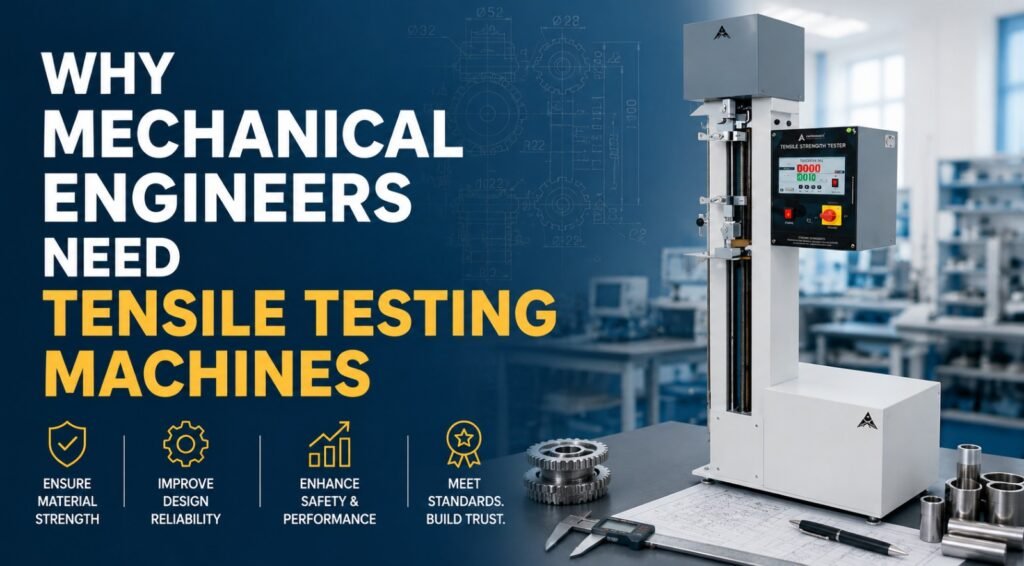
When engineers design a component, they rely on spec sheets and CAD models to simulate stress. Simulations are an excellent way to look at what should happen under ideal conditions. Unfortunately, this is not the case in real life due to differences in batches of material, manufacturing methods producing defects, and suppliers sending poor-quality materials.
A tensile test pulls a physical specimen until it breaks. By using this physical data, engineers can calculate two sets of strength measurements that give actual values. Therefore, you can determine whether or not your component will perform as expected in the real world.
Need for a Tensile Testing Machine for Mechanical Engineers
For detailed material specifications and property calculations, explore our process & mechanical design specification guides that integrate material testing data into engineering workflows.
Engineers have to balance safety factors with material costs. If they exaggerate a part because you lack precise data, you waste money and add unnecessary weight. Having this machine in a facility bridges that gap, turning theoretical calculations into verified physical proof. The following are the important reasons why mechanical engineers heavily depend on tensile testing machines:
Transition From Theory to Physical Proof
Our engineering design calculators help translate material test data into verified design parameters.
Sometimes a software simulation will only go so far until you need to get physical validation. A tensile testing machine connects digital stress analysis with the properties of materials under stress by physically testing a specimen. These steps take the guesswork out of structural design.
Think about Finite Element Analysis for a second. You plug in numbers, run a mesh simulation, and get a beautiful color-coded map showing stress distribution. But those results are only as good as the material property inputs you entered. If the actual alloy has slight variations in its grain structure, your simulation is wrong. Running a physical pull test gives you the true stress-strain curve for that specific batch of material.
This verification becomes incredibly important when you change material suppliers or try to optimize production costs. You cannot just take a new vendor’s word that their steel or polymer behaves exactly like your previous option. Testing a few samples on the floor tells you within minutes if the new material meets your design constraints. It protects the engineering team from relying blindly on paperwork.
Prevent Catastrophic Structural Failures
See our pressure vessel design guide for material selection principles in critical applications.
Predicting exactly when and how a component will break is the best way to prevent dangerous field failures. A tensile testing machine shows you the precise point where a material stops stretching and permanently deforms. Understanding this limit keeps your final products working safely.
Materials usually give warning signs before they snap completely. They stretch, narrow down in a specific spot, and deform plastically. Engineers need to know exactly where this transition happens so they can set safe operational limits. If a part in a hydraulic system or a vehicle chassis stretches permanently under a normal load, the whole system fails.
By observing the fracture style during a test, you also learn about material behavior. A sharp break means a brittle material that could suffer sudden failure without warning when subjected to impact. A long, elongated break has ductility, typically desired to absorb energy. This knowledge will aid you in selecting the ideal material combination for high stress applications.
Standardized Quality Control in Manufacturing
Quality control is critical in manufacturing. Explore our reliability-centered maintenance strategies that include material verification protocols.
For consistent manufacturing, there is a need for a constant check of raw materials entering the shop floor. A tensile testing machine integrated into the production process will identify quality failures at the earliest opportunity, before the material is cut or formed into a product. This step saves massive amounts of time and reduces scrap rates.
When raw materials arrive at a factory, quality control teams usually look at mill certificates. But certificates can contain errors or represent a different part of a large production run. By cutting small test coupons from incoming stock and pulling them, you instantly confirm the mechanical properties match your engineering requirements.
Catching a low-strength batch of steel or a brittle polymer mix at the receiving dock prevents massive headaches later. If bad material makes it to the CNC machines or welding stations, you waste labor and tool wear on parts that you will eventually have to throw away. It turns quality control into a proactive habit rather than a reactive fix after a customer complains.
Selection of Components and Optimizing Designs
Component optimization requires precise data. Check out our complete chemical equipment design guide for material selection workflows and our equipment design principles for real-world applications.
Choosing the right equipment vendor is just as important as selecting the right raw materials for a project. Engineers rely on calibrated machinery from Testronix Laboratory Testing Instruments to ensure their data remains highly accurate and repeatable across different product lines. High-quality testing gear gives engineers data they can actually stand behind during design reviews.
When you evaluate different testing setups, the build quality of the load cells and the gripping mechanisms determines data accuracy. If a machine flexes or the grips slip during a high-load pull, your elongation readings become completely useless. Working with precise systems makes a huge difference when you try to fine-tune material thicknesses to save weight.
In other words, the importance of optimized design lies in the small alterations to processes leading to differences with the different types of materials based on how they were processed. Thus, an even surface will allow for the precise identification of these small variances. When you receive accurate testing results through testing instruments, this allows you to safely expand design limits by removing unnecessary material from the part.
Conclusion
A tensile testing machine is not just a laboratory tool for research projects. It is a fundamental piece of equipment that keeps mechanical designs safe, accurate, and cost-effective. Integrating dependable systems from Testronix Laboratory Testing Instruments into your workflow helps maintain a strict standard of quality from the initial prototype phase all the way to final production. Investing in physical testing ultimately protects your engineering reputation and ensures your products perform reliably out in the field.

